
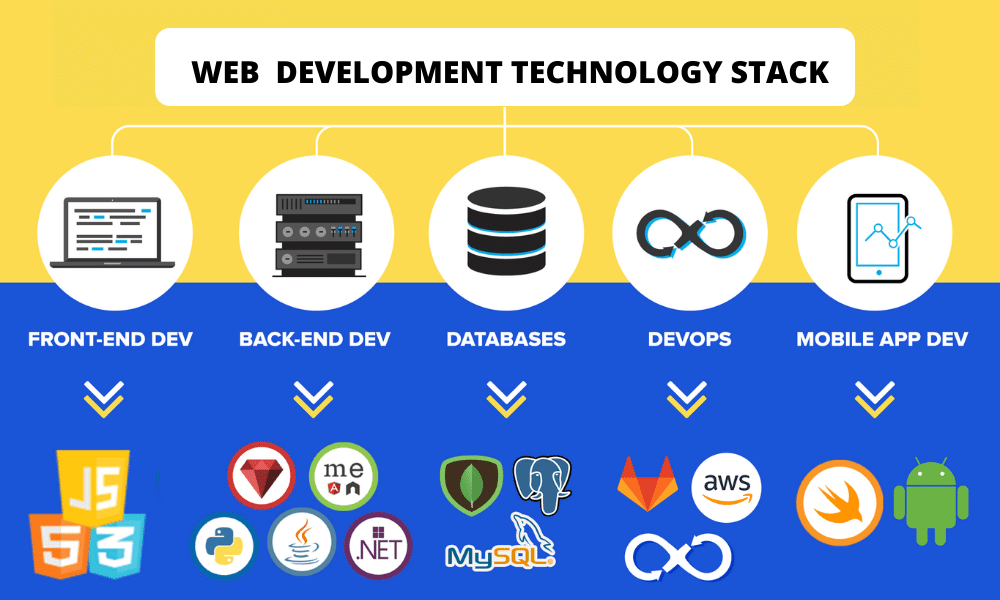
Backend Web Development powers the server-side of web applications — the part users don’t see but rely on every time they interact with a website or app. It handles data storage, security, authentication, server logic, and communication between the database and the frontend.
A backend developer ensures that when a user clicks a button or submits a form, the right data is processed, stored, and delivered back correctly.
Key responsibilities include:
-
Building APIs (REST, GraphQL) to connect frontend and backend
-
Managing Databases (SQL & NoSQL)
-
Implementing Authentication & Security (password hashing, JWT, OAuth)
-
Optimizing Performance & Scalability
-
Server & Hosting Management
Roadmap to Becoming a Backend Developer
1. Fundamentals of Backend Development
Start with the basics:
-
How the web works (HTTP, client-server model)
-
Understanding servers and browsers
-
Learn a backend programming language:
-
JavaScript (Node.js)
-
OR Python (Django/Flask)
-
OR PHP (Laravel)
-
OR Java (Spring Boot)
-
OR C# (.NET)
-
Projects: Simple API that returns data, form submission handling.
2. Databases
Learn how to work with data:
-
Relational Databases (SQL): MySQL, PostgreSQL
-
NoSQL Databases: MongoDB, Firebase
-
Database design (tables, relations, indexes)
-
Writing queries (CRUD operations)
Projects: Blog system with database, user registration & login.
3. Server-Side Frameworks
Use frameworks to speed up development:
-
Node.js Frameworks: Express.js, NestJS
-
Python: Django, Flask, FastAPI
-
PHP: Laravel, Symfony
-
Java: Spring Boot
Projects: REST API for a product catalog, authentication system.
4. APIs & Data Communication
Connect frontend and backend:
-
REST API design
-
GraphQL basics
-
JSON & XML formats
-
API Authentication (JWT, OAuth2, Sessions, Cookies)
Projects: Weather API, chat API, or movie search API.
5. Authentication & Security
Protect your apps:
-
User authentication (sign-up, login, password hashing)
-
Authorization (roles & permissions)
-
HTTPS & SSL basics
-
Preventing attacks: SQL Injection, XSS, CSRF
Projects: Secure login system, admin dashboard.
6. Advanced Backend Skills
Take your skills further:
-
File upload & storage (e.g., AWS S3, Cloudinary)
-
Payment gateway integration (Stripe, PayPal)
-
Real-time communication (WebSockets, Socket.io)
-
Caching (Redis, Memcached)
-
Message Queues (RabbitMQ, Kafka)
Projects: Chat app, e-commerce backend, booking system.
7. Deployment & DevOps Basics
Learn to put your backend online:
-
Hosting (Heroku, AWS, DigitalOcean, Render)
-
CI/CD pipelines (GitHub Actions, Jenkins)
-
Docker basics (containerization)
-
Monitoring & Logging (PM2, ELK stack)
Projects: Deploy your backend API, set up auto-deployment.
8. Testing & Best Practices
Write clean, maintainable, and bug-free code:
-
Unit testing (Jest, Mocha, PyTest)
-
Integration testing
-
API testing (Postman, Newman)
-
Clean architecture & design patterns (MVC, Microservices)
Career Outcomes
By following this roadmap, you can work as:
-
Backend Developer
-
API Developer
-
Node.js / Django / Laravel Developer
-
Database Administrator (DBA)
-
Full Stack Developer (if you combine frontend skills)